 SeaMemo
Windward and Leeward: What They Mean on a Boat, Plus Every Point of Sail
Windward is the side facing the wind, the direction the wind comes from. Leeward is the side sheltered from it, the direction the wind blows towards. That works for your boat as much as for an island or a buoy. On board the quickest clue is the boom: it is carried on the leeward side, so windward is the opposite side. The points of sail describe your angle to the wind: close hauled (about 45 degrees), beam reach (90 degrees), broad reach (about 135 degrees) and running (180 degrees). No sailing boat can sail straight into the wind.
Windward and leeward: what they mean
Windward and leeward are directions relative to the wind. Windward is upwind of a point of reference, facing the direction the wind comes from. Leeward is downwind of it, towards where the wind is going. In the age of sail, weather was used as a synonym for windward, which is why sailors still say weather side, weather helm or weather shore. The side of a ship towards leeward is its lee side.
Both words are relative. An island lies to leeward of your boat when the wind reaches you first and the island second. If the island sits between you and the wind, you are in the lee of the island and enjoy calmer water. The same idea names whole island groups: in an archipelago, windward islands lie upwind of the prevailing winds such as the trade winds, and leeward islands downwind.
Simplified, not to scale. On the left the same points of sail with the wind on the other side. Angles are a guide, how close a boat can point depends on the boat.
| Windward | Leeward | |
|---|---|---|
| Position to the wind | facing the wind | away from the wind |
| Mainsail and boom | on the opposite side | carried on this side |
| Heel | the high side | the low side, the boat leans to leeward |
| Water along the hull | wind and waves hit it | noticeably calmer |
| Rule 12, same tack | keeps out of the way | stand on boat |
| Other names | weather side, upwind | lee side, downwind |
How to tell which side is windward
- Masthead wind indicator. The vane or arrow at the top of the mast shows where the wind comes from on board. That direction is windward.
- The boom. The boom and mainsail are carried on the leeward side, so windward is the opposite side. That is exactly how the COLREGs define the windward side (Rule 12 b). It helps most when running, when you barely feel the wind.
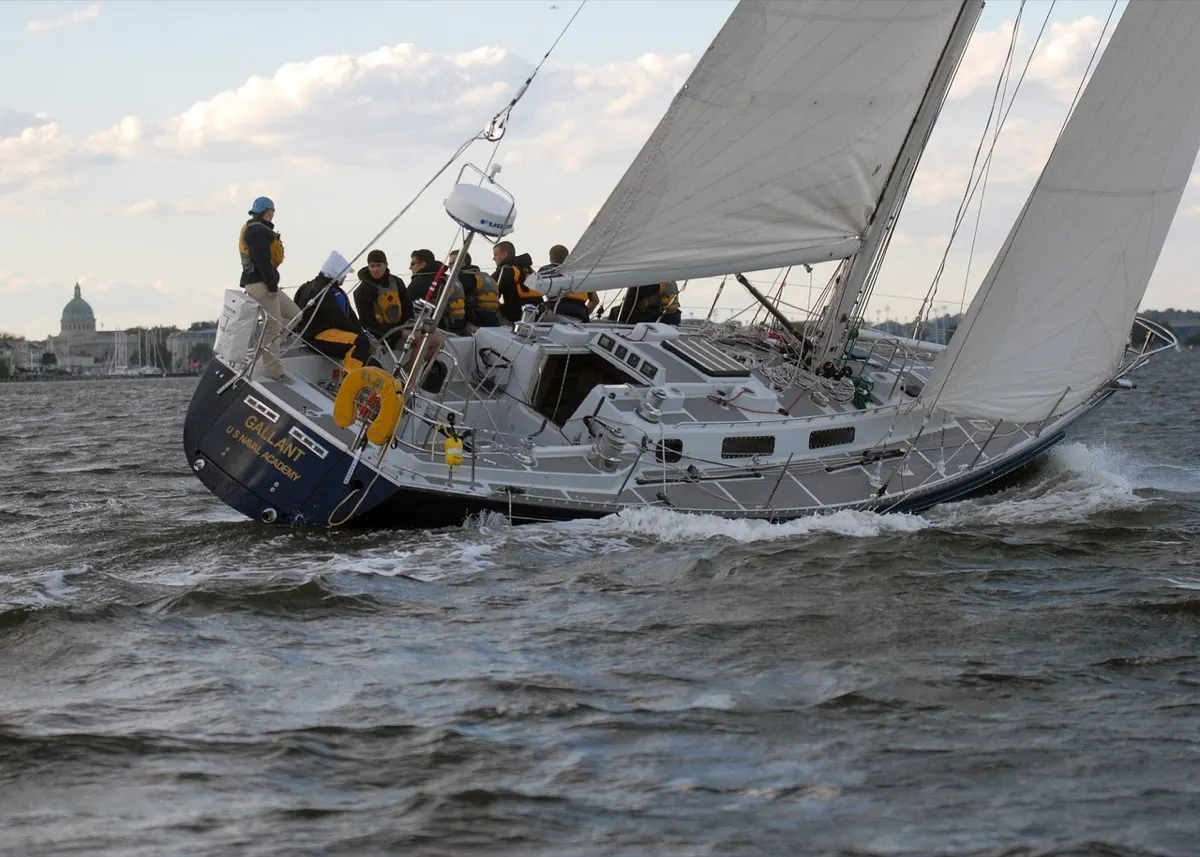
- Heel. Under sail the boat leans to leeward. The high side is windward, the low side with the water near the rail is leeward.
- Face the wind. Turn until you feel the wind evenly on both cheeks and ears. You are now looking to windward, and leeward is behind you.
- Flags and smoke. The courtesy flag, flags ashore or smoke all stream out to leeward.
Memory aids and where the words come from
- Lee means shelter. The word comes from the Old Norse hle, cover. Leeward is the sheltered side, out of the wind.
- Windward is towards the wind. The suffix ward means turned towards, as in homeward. Windward simply means towards the wind.
- Never spit to windward. Spitting, peeing or throwing scraps over the side only ever happens to leeward. Try it the other way once and you will never mix the two up again.
- Two ways to say it. Leeward is pronounced LEE-ward or LOO-ard. If someone on the dock says LOO-ard, they mean exactly the same thing.
The points of sail
A point of sail is your direction of travel in relation to the wind. It decides how you trim the sails and how the boat feels. The angles below are a guide: how close a boat can point depends on its hull, keel and sails.
| Point of sail | Angle to the wind (guide) | Sails |
|---|---|---|
| In irons (no go zone) | 0 to roughly 45 degrees either side | flogging, no drive |
| Close hauled | as close as the boat will go, about 30 to 45 degrees on modern yachts | sheeted in hard, flat |
| Close reach | between close hauled and a beam reach | in, but a little eased |
| Beam reach | about 90 degrees, wind on the beam | about halfway out |
| Broad reach | wind from behind at an angle, around 135 degrees | well eased, fuller shape |
| Running | 180 degrees, wind from dead astern | eased right out |
In irons: the no go zone
Point too close to the wind and the sails cannot generate lift. They flog and the boat slows to a stop, which sailors call being in irons. For many boats this zone reaches about 45 degrees either side of the wind, typically somewhere between 30 and 50 degrees. If your destination lies dead upwind, you have to beat: zigzag close hauled, tacking at the end of each leg.
Close hauled and close reach
Close hauled, the sails are trimmed in tightly and work like a wing, and the boat heads as close to the wind as it can. This is where the boat heels most and makes the most leeway. A boat that points higher is called more weatherly. Pinch too close and speed drops off sharply, so the fastest way upwind is often a few degrees lower. Ease the sheets a little and bear away from close hauled and you are on a close reach.

Beam reach
On a beam reach the wind comes from directly abeam, at a right angle to the boat. The sails are eased about halfway, heel is moderate and the waves come from the side. Because lift does most of the work here, sailing boats reach their highest speeds on a reach, and many cruising yachts are at their most comfortable.
Broad reach
On a broad reach the wind comes from behind at an angle, over the quarter. The sails are eased well out. This is where many crews hoist a spinnaker or gennaker, and it is the point of sail you gybe from.

Running
Running, or sailing dead downwind, the wind comes from directly astern and the sails work mainly by drag, like a parachute. The boat rolls, can be hard to steer and an accidental gybe is always close. A preventer secures the boom, and setting the headsail on the opposite side is called sailing wing on wing. On a run a boat cannot go faster than the true wind, so performance boats often sail a series of broad reaches and gybe instead. How to gybe safely is in our guide to tacking and gybing.
Luffing up and bearing away
Every change of point of sail is either a luff up or a bear away. To luff up, or head up, is to steer closer to the wind, and you sheet the sails in. To bear away, or fall off, is to turn the bow to leeward, and you ease the sheets. With a tiller it works the other way round: push the tiller to leeward to luff up, pull it to windward to bear away. With a wheel you simply turn it the way you want the bow to go.
Turn the bow right through the wind and you have tacked. Turn the stern through the wind and you have gybed. After either, the wind is on the other side and windward and leeward swap.
True wind and apparent wind
The wind you feel on a moving boat is not the wind a stationary observer measures. The true wind is the wind over the surface. Add the headwind created by the boat's own speed and you get the apparent wind, the wind shown by the masthead indicator and wind instruments. You trim the sails to the apparent wind.
A true wind from ahead adds to the wind you feel, a true wind from astern takes away from it. That is why the wind seems light when you are running and suddenly much stronger when you round up onto a close reach. Before you turn back upwind after a long run, check how much wind there really is. What each wind force means is in our guide to the Beaufort scale.
Windward and leeward in practice
- Anchoring in the lee. A bay in the lee of an island or headland is sheltered from wind and waves. If the wind shifts, that shelter can turn into a lee shore. How to pick the spot and the scope is in our guide to anchoring.
- Lee shore. A lee shore is a coast on the leeward side of your boat, with the wind blowing towards the land. Because of the danger of being driven aground, give it plenty of room, especially at night and in strong winds.
- Crew to windward. In a breeze the crew sits on the high windward side and uses its weight to keep the heel down.
- Weather helm. A heeling boat tends to turn towards the wind, so you pull the tiller to windward to hold course. A little weather helm is normal. If it gets heavy, the boat usually carries too much sail: reef, ease the mainsheet or move weight to windward.
- Pick up from the lee side. The water is calmer in the lee of the hull, which makes the lee side the natural place to bring a tender, a pilot or a person in the water alongside.
- Berthing. The wind pushes the boat to leeward. Plan your approach and lines with that drift in mind. Our guide to docking a boat shows how.
Which Mediterranean winds blow from which direction, and where that leaves you in the lee, is shown in our guide to Mediterranean winds, with a wind rose.
Windward and leeward in the COLREGs
Rule 12 of the International Regulations for Preventing Collisions at Sea (COLREGs) decides who gives way when two sailing vessels meet:
- Wind on different sides: the boat with the wind on its port side keeps out of the way (Rule 12 a i). In everyday terms, port tack gives way to starboard tack.
- Wind on the same side: the windward boat keeps out of the way of the leeward boat (Rule 12 a ii). The windward vessel is normally the more manoeuvrable one.
- Not sure: a boat on port tack that sees a boat to windward and cannot tell its tack keeps out of the way (Rule 12 a iii).
- Definition: the windward side is the side opposite to that on which the mainsail is carried (Rule 12 b).
Who gives way to motorboats, fishing vessels and ferries is covered with diagrams in our guide to the COLREGs right of way rules. The fixed sides of a boat are explained in port and starboard.
Recording the wind and your point of sail
A traditional logbook records course, wind direction and wind strength. SeaMemo fills in a lot of it for you: it records every leg by GPS tracking, with the route as a line on the map, the nautical miles, the duration and the average speed. When you finish a leg you add the weather. If you beat upwind, every tack shows up on the map later.
What the numbers cannot know goes into the journal: “Beam reach to Leros, flat water in the lee of the island”. The whole crew can add entries and photos, and everything stays together in the trip.


Common mix ups
- Lee sounds safe, a lee shore is not. You are sheltered in the lee of an island. A shore to leeward of your boat is the one the wind is pushing you onto.
- Windward is not left or right. Port and starboard belong to the boat, windward and leeward to the wind. They swap sides every time you tack or gybe.
- Close hauled does not mean a lot of wind. It means sailing as close to the wind as the boat will go, in any wind strength.
- Running is not the fastest point of sail. Most sailing boats are quicker on a reach than dead downwind.
- Windward gives way only on the same tack. On opposite tacks, the boat with the wind on its port side gives way.
- Masthead and forecast show different winds. The masthead indicator shows the apparent wind on board, the forecast the true wind.
Sources
- Wikipedia: Windward and leeward: meaning, origin, weather as a synonym, Rule 12, island groups
- Wikipedia: Point of sail: no go zone, close hauled, reaching, running, speeds on each point of sail
- Wikipedia: Apparent wind
- Wikipedia: Glossary of nautical terms: luff up, bear away, fall off, lee helm, weather side
- Wikipedia: Weather helm and Lee shore
- Wikipedia: Kurse zum Wind (German): pointing angles of square riggers and modern yachts
- COLREGs Rule 12, sailing vessels
Get SeaMemo for free
Logbook, travel journal and crew in one app. For iPhone and Android, works offline at sea.


Frequently asked questions
What is the difference between windward and leeward?
Windward is the side or direction the wind comes from, leeward the side or direction it blows towards. On a sailing boat the mainsail is carried on the leeward side, and the opposite side is windward. The terms are relative: a boat lies in the lee of an island when the island is between the boat and the wind.
How do you pronounce leeward?
You will hear both LEE-ward and LOO-ard, and dictionaries list both. They mean the same thing: downwind of the point of reference.
How do I know which side is windward on a boat?
Look at the wind indicator at the masthead, which shows the wind direction on board, at the boom, which is on the leeward side, and at the heel: the boat leans to leeward, so the high side is windward. The COLREGs define the windward side as the side opposite to the one on which the mainsail is carried (Rule 12 b).
What are the points of sail?
In irons (the no go zone, roughly 45 degrees either side of the wind), close hauled, close reach, beam reach at about 90 degrees, broad reach with the wind on the quarter, and running with the wind from dead astern. How close to the wind a boat can point depends on the boat.
Who has right of way, windward or leeward?
Under COLREGs Rule 12, when two sailing vessels have the wind on the same side, the windward boat keeps out of the way of the leeward boat. When they have the wind on different sides, the boat with the wind on its port side gives way.
What do luff up and bear away mean?
To luff up, or head up, is to steer closer to the wind. To bear away, or fall off, is to steer away from the wind towards leeward. With a tiller you push it to leeward to luff up and pull it to windward to bear away.