 SeaMemo
NATO Phonetic Alphabet: the Military Alphabet from Alfa to Zulu, with Numbers and Radio Use
The NATO phonetic alphabet, often called the military alphabet, is the international spelling alphabet for voice radio: Alfa, Bravo, Charlie, Delta, Echo, Foxtrot, Golf, Hotel, India, Juliett, Kilo, Lima, Mike, November, Oscar, Papa, Quebec, Romeo, Sierra, Tango, Uniform, Victor, Whiskey, X-ray, Yankee, Zulu. Each word stands for its first letter. The list dates from 1956 and is used in aviation, by the military and on marine VHF. On board you use it to spell your boat name, your call sign and anything else that must not be misheard.
The NATO phonetic alphabet from A to Z
This is the list as spelled by ICAO, the International Civil Aviation Organization. The pronunciation column follows the ICAO respelling, with the stressed syllable in capitals. The flag next to each letter is the signal flag for the same letter, explained in our guide to nautical flags.
| Flag | Letter | Code word | Pronunciation |
|---|---|---|---|
| A | Alfa | AL-fah | |
| B | Bravo | BRAH-voh | |
| C | Charlie | CHAR-lee | |
| D | Delta | DELL-tah | |
| E | Echo | ECK-oh | |
| F | Foxtrot | FOKS-trot | |
| G | Golf | GOLF | |
| H | Hotel | ho-TELL | |
| I | India | IN-dee-ah | |
| J | Juliett | JEW-lee-ETT | |
| K | Kilo | KEY-loh | |
| L | Lima | LEE-mah | |
| M | Mike | MIKE | |
| N | November | no-VEM-ber | |
| O | Oscar | OSS-cah | |
| P | Papa | pah-PAH | |
| Q | Quebec | keh-BECK | |
| R | Romeo | ROW-me-oh | |
| S | Sierra | see-AIR-rah | |
| T | Tango | TANG-go | |
| U | Uniform | YOU-nee-form | |
| V | Victor | VIK-tah | |
| W | Whiskey | WISS-key | |
| X | X-ray | ECKS-ray | |
| Y | Yankee | YANG-key | |
| Z | Zulu | ZOO-loo |
Three things stand out: Alfa is spelled with an f, Juliett with a double t, and a few words do not sound the way you might expect, such as “VIK-tah” and “OSS-cah”. The reasons are further down.
Numbers on the radio: digit by digit
On the radio you do not say a number as a whole, you say it digit by digit. The IMO Standard Marine Communication Phrases (SMCP) for shipping give the digits their own pronunciation:
| Digit | Word | Pronunciation (IMO) | ITU code word |
|---|---|---|---|
| 0 | zero | ZEERO | Nadazero |
| 1 | one | WUN | Unaone |
| 2 | two | TOO | Bissotwo |
| 3 | three | TREE | Terrathree |
| 4 | four | FOWER | Kartefour |
| 5 | five | FIFE | Pantafive |
| 6 | six | SIX | Soxisix |
| 7 | seven | SEVEN | Setteseven |
| 8 | eight | AIT | Oktoeight |
| 9 | nine | NINER | Novenine |
| 1000 | thousand | TOUSAND |
- 150 is “one five zero”, not “one hundred and fifty”.
- 2.5 is “two decimal five” or “two point five”.
- Channel 16 therefore becomes “channel one six”.
- Positions are given in degrees and minutes, with decimals of a minute if needed, plus North or South and East or West.
The odd forms are there for a reason. “Tree” keeps three from turning into “sri” in the mouths of speakers who have no th. “Fower” keeps four apart from the word “for”, and “fife” keeps five apart from “fire”. “Niner” has a second syllable so that nine does not sound like the German “nein”. The International Telecommunication Union (ITU) also has compound code words such as Unaone and Bissotwo. The IMO phrases use the plain English digits.
Your boat name in the NATO alphabet
The line under the tiles is what you say on the radio. Accents are dropped, and digits appear the way they are pronounced on air.
Alfa or Alpha, Juliett or Juliet?
Officially it is Alfa and Juliett. The spellings are deliberate: not every language reads “ph” as f, and French speakers might treat a single final t as silent. In everyday use you will still see Alpha and Juliet, even in official papers: the spelling table in the IMO phrases has Juliet and Whisky. On the radio it makes no difference, because both sound the same.
The name varies too. NATO alphabet, military alphabet, aviation alphabet, pilot alphabet and ICAO alphabet all mean the same list, whose official name is the International Radiotelephony Spelling Alphabet. It is called phonetic, but it has nothing to do with the International Phonetic Alphabet that linguists use to write down sounds.
How to spell on the radio
On a boat you need the alphabet for four things above all: boat name, call sign, MMSI and position. The call sign and MMSI belong to the boat's radio. Ask for both at the charter handover and write them down.
- Say the word, then spell it. “I spell” announces that you are about to spell: “Sailing yacht Mila, I spell: Mike India Lima Alfa.”
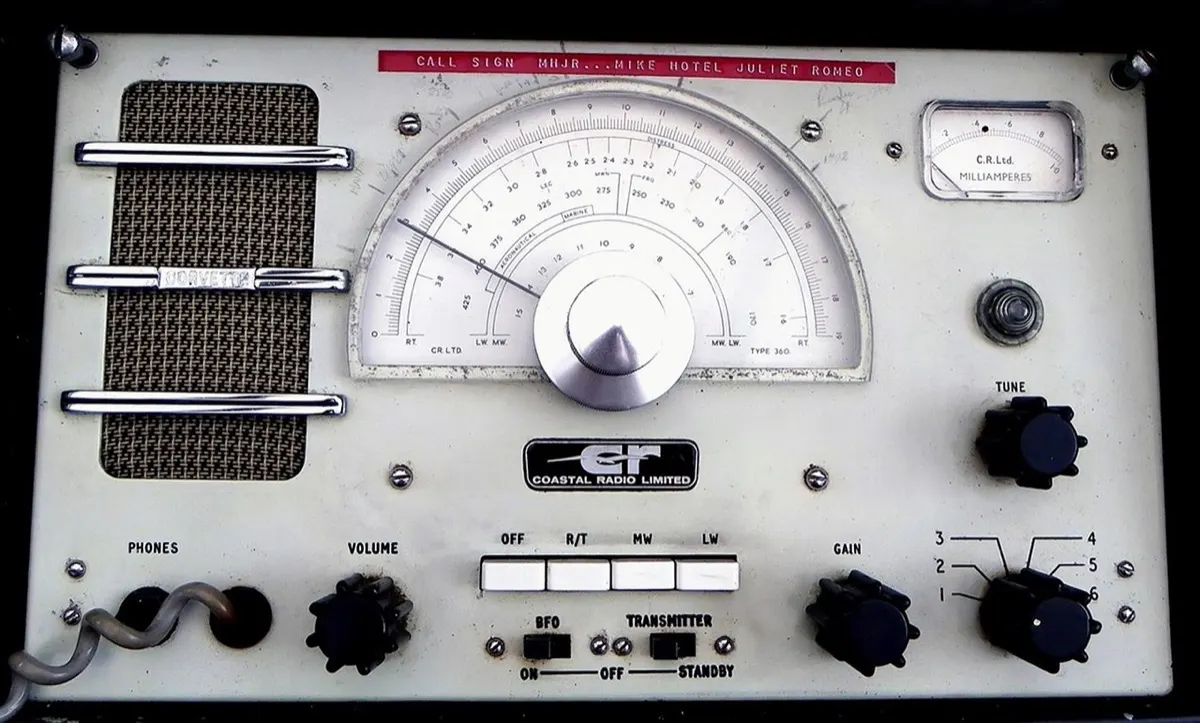
- Always give the call sign in code words. On the old ship's radio in the photo above it is even printed on the label: MHJR, Mike Hotel Juliet Romeo.
- One digit at a time. Say the nine digits of the MMSI one after another, for example “two one one two three nine six eight zero”.
- Speak slowly and evenly. Leave a short pause between the code words.
- Correct mistakes. If you get something wrong, the IMO phrases have you say “Mistake”, then “Correction” and the corrected part.
- Ask again. If you did not catch something, say “Say again”. To stress something important, say “Repeat” and say it once more.
Home made words such as “S for Sugar” have no place on marine radio. The IMO phrases are clear on this: when spelling is necessary, only the international table is used. The person at the coast station may speak Croatian, Greek or Italian, but they know Alfa, Bravo, Charlie.
The distress message: every character counts
According to the IMO phrases, the spoken distress message has the following parts. It follows the digital distress alert (DSC) and on VHF it goes out on channel 16:
- MAYDAY
- THIS IS, then the MMSI digit by digit, the vessel's name and the call sign in code words
- Position in degrees and minutes
- Nature of distress
- Assistance required
- Any other information that helps the rescue, ending with OVER
“Position four three degrees three zero decimal five minutes North, zero one six degrees two five decimal zero minutes East.”That is how 43° 30.5′ N, 016° 25.0′ E sounds: latitude with two digits, longitude with three digits before the word degrees.
The full procedure, with the distress call, the repetitions and radio discipline, is what you learn on a VHF radio course such as the Short Range Certificate. When to use Mayday, Pan Pan or Sécurité and how to cancel a false alert is explained in our guide to the Mayday call. Keep the short version on a card next to the radio, with boat name, call sign and MMSI already filled in.

Military, aviation, police: is it all the same alphabet?
Military alphabet and aviation alphabet are two names for the NATO alphabet. The police alphabet is a different story. In the United States many departments still use an older list published by the public safety communications association APCO in the 1940s, which starts Adam, Boy, Charles. APCO itself switched to the international alphabet in 1974, but the Los Angeles Police Department and others kept the old words. And if your grandfather says Able, Baker, Charlie, he learned the US military alphabet of 1941, which the Royal Air Force also adopted during the Second World War.
| NATO alphabet, since 1956 | Able Baker, US military from 1941 | Police alphabet, LAPD | |
|---|---|---|---|
| A | Alfa | Able | Adam |
| B | Bravo | Baker | Boy |
| C | Charlie | Charlie | Charles |
| D | Delta | Dog | David |
| E | Echo | Easy | Edward |
| F | Foxtrot | Fox | Frank |
| G | Golf | George | George |
| H | Hotel | How | Henry |
| I | India | Item | Ida |
| J | Juliett | Jig | John |
| K | Kilo | King | King |
| L | Lima | Love | Lincoln |
| M | Mike | Mike | Mary |
| N | November | Nan | Nora |
| O | Oscar | Oboe | Ocean |
| P | Papa | Peter | Paul |
| Q | Quebec | Queen | Queen |
| R | Romeo | Roger | Robert |
| S | Sierra | Sugar | Sam |
| T | Tango | Tare | Tom |
| U | Uniform | Uncle | Union |
| V | Victor | Victor | Victor |
| W | Whiskey | William | William |
| X | X-ray | X-ray | X-ray |
| Y | Yankee | Yoke | Young |
| Z | Zulu | Zebra | Zebra |
On the telephone, people in Britain still say “F for Freddie” or “S for Sugar”, leftovers from the wartime lists. On marine radio none of these alphabets is used. There, only the international one counts.
Where the NATO alphabet comes from
Spelling alphabets are as old as the telephone and radio. The first one to be recognised internationally was produced by the International Telecommunication Union in 1927, mostly from the names of cities and countries. In the 1932 version it began Amsterdam, Baltimore, Casablanca. In 1941 the United States military adopted its own list, known as “Able Baker” after its first two words. Because these lists leaned heavily on English, civil aviation got a new version on 1 November 1951 that already sounded almost like today's: Alfa, Bravo, Coca, Delta, Echo.
After tests with speakers from 31 nations, five words were replaced: Coca, Metro, Nectar, Union and Extra gave way to Charlie, Mike, November, Uniform and X-ray. The list took effect on 1 March 1956, at ICAO and in NATO. A few years later the ITU adopted it for all radio traffic. Because NATO allies had led the final revision, the name NATO phonetic alphabet stuck. The 26 words have not changed since 1956.
How to learn the 26 words quickly
- In four blocks: Alfa to Golf, Hotel to November, Oscar to Uniform, Victor to Zulu. One block a day is enough.
- Practise in everyday life: spell number plates, street names and, in the marina, the boat names along the pontoon.
- Your own first: you should be able to spell your name, the boat name and the call sign without thinking.
- In pairs: one person spells, the other writes it down. You notice at once where it goes wrong.
Common mistakes
- Saying nine and three the everyday way. On the radio it is niner and tree.
- Saying numbers as a whole. Channel 72 is “seven two”, not “seventy two”.
- Mixing alphabets. “N for Nan” or “N for Nora” may be understood at home, but not by a coast station abroad.
- Speaking too fast. Each code word is a word of its own, with a short pause after it.
- Writing Alpha and Juliet. Spoken it is the same, but the official spelling is Alfa and Juliett.
- Confusing it with the phonetic alphabet of linguistics. The NATO alphabet spells letters, it does not describe sounds.
Radio practised, trip in the logbook
SeaMemo is not a radio and replaces neither a radio licence nor a distress call. The app is your logbook: GPS tracking records your route and nautical miles, offline too, and the emergency know-how for man overboard, Mayday and fire on board is on your phone. You plan the safety briefing as a shared checklist, and whatever happened on the radio goes into a journal entry for the leg. What else belongs in there is covered in our guide on how to keep a sailing logbook.


If you are learning the phonetic alphabet, the channel markers and buoys and the COLREGs right of way rules are probably on your list as well.
Sources
- IMO: Standard Marine Communication Phrases, Resolution A.918(22) (PDF): spelling table, pronunciation of digits, numbers, positions, corrections and the structure of the distress message
- NATO: The NATO phonetic alphabet: history from 1927 to 1956 and the spellings
- Wikipedia: NATO phonetic alphabet: ICAO respelling, digits, ITU code words, tests with 31 nations
- Wikipedia: APCO radiotelephony spelling alphabet: the police alphabet
- Wikipedia: Procedure word: “I spell” and other radio procedure words
- Wikipedia: Mayday: the distress call
Get SeaMemo for free
Logbook, travel journal and crew in one app. For iPhone and Android, works offline at sea.

Frequently asked questions
What is the NATO phonetic alphabet?
Alfa, Bravo, Charlie, Delta, Echo, Foxtrot, Golf, Hotel, India, Juliett, Kilo, Lima, Mike, November, Oscar, Papa, Quebec, Romeo, Sierra, Tango, Uniform, Victor, Whiskey, X-ray, Yankee, Zulu. Each word stands for its first letter.
Is it Alfa or Alpha?
Officially Alfa, and Juliett with a double t. The spellings were chosen so that speakers of as many languages as possible pronounce the words correctly. Spoken, there is no difference, which is why you often see Alpha and Juliet as well.
Are the military alphabet, the aviation alphabet and the NATO alphabet the same thing?
Yes. All three names mean the International Radiotelephony Spelling Alphabet. It was defined by the International Civil Aviation Organization, took effect in NATO on 1 March 1956 and was later adopted for all radio traffic, including at sea.
How do you say numbers on the radio?
Digit by digit: zero, wun, too, tree, fower, fife, six, seven, ait, niner. So 150 is one five zero and 2.5 is two decimal five.
Why do you say niner instead of nine?
Nine was given a second syllable so that it cannot be mistaken for the German word nein, which means no. For similar reasons three is tree, four is fower and five is fife.
Do the police use the NATO alphabet?
Not always. Many police departments in the United States still use an older list that starts Adam, Boy, Charles. At sea and in the air only the international alphabet is used.