 SeaMemo
Man overboard procedure: what counts in the first seconds and how to get the person back aboard
If someone goes overboard, the first seconds count. A good man overboard procedure starts like this: shout “Man overboard” loudly, name one person who does nothing but point at the person in the water, throw a lifebuoy or horseshoe buoy at once, press the MOB button on the GPS and send a Mayday on the radio. Then stop the boat and return with a short manoeuvre: under sail usually the Quick Stop, under engine only with the propeller out of gear close to the person. The British Marine Accident Investigation Branch (MAIB) found that in cold water crews have on average less than 11 minutes before the person can no longer help with their own rescue.
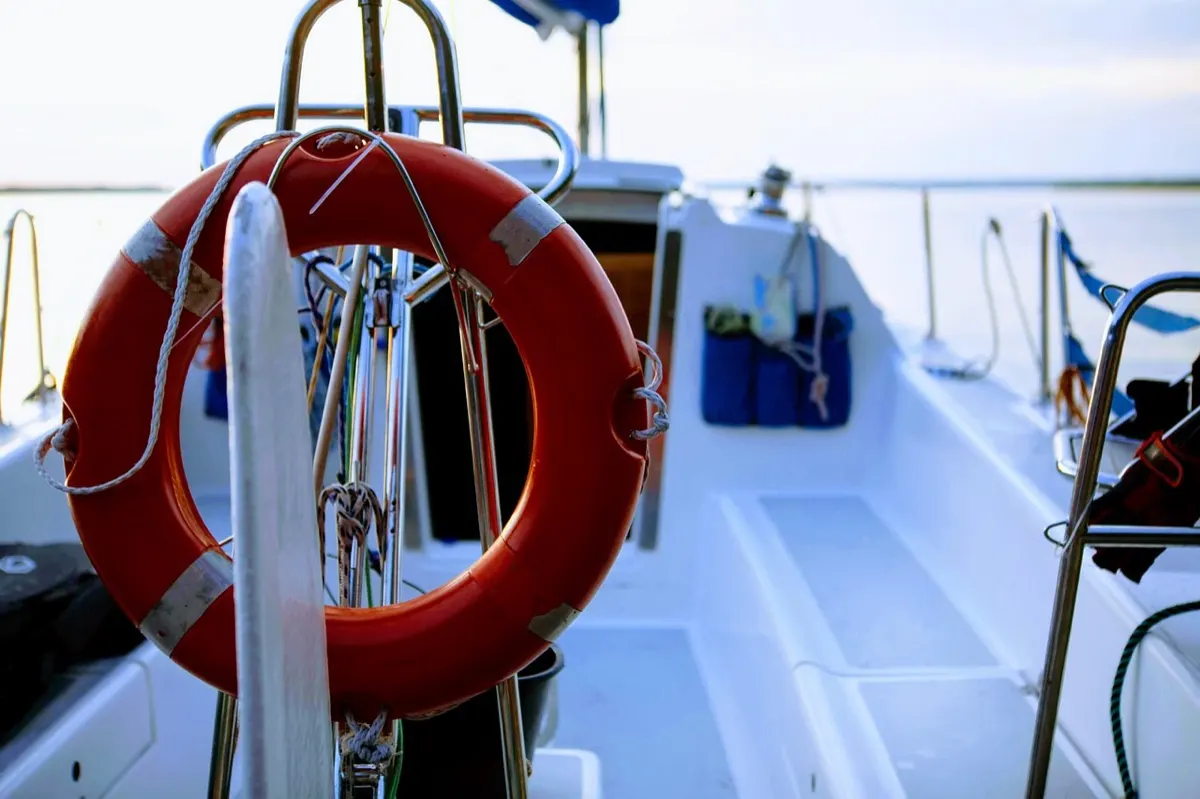
The first seconds: six immediate actions
The order follows the advice of the Royal Yachting Association (RYA), the British sailing association, and the checklist of the German Maritime Search and Rescue Service (DGzRS). With enough people on board, much of it happens at the same time.
- Raise the alarm. Whoever sees it shouts “Man overboard” loudly and clearly. The German rescuers now say “Mensch über Bord”, person overboard, which means the same.
- One person points. The skipper names someone who never takes their eyes off the person in the water and points at them with an outstretched arm. That person does nothing else.
- Throw rescue equipment. Lifebuoy, horseshoe buoy, throwing line and anything that floats and is easy to see, as close to the person as possible. It gives buoyancy and marks the spot.
- Press the MOB button. The GPS plotter then stores the last known position. The DGzRS calls it the POB button; it used to be called MOB.
- Send a Mayday. DSC distress alert and distress message on VHF channel 16, more on that below.
- Stop the boat and go back. Take the way off the boat so the distance does not grow, and start the return manoeuvre. At the same time, prepare the recovery.
Man overboard as a checklist
- Shout “Man overboard”
- Name a pointer, never lose sight of the person
- Throw a lifebuoy or horseshoe buoy
- MOB button on the GPS
- Mayday and DSC distress alert
- Take the way off, sail the manoeuvre, prepare the recovery
How much time you have
The British Marine Accident Investigation Branch (MAIB) analysed 20 accidents from 2017 to 2021. The result: in cold water crews had on average less than 11 minutes before the person stopped responding. The colder the water and the rougher the sea, the shorter the time, in some cases only 4 or 5 minutes. Of 308 cases reported between 2015 and 2023, 40 percent were fatal, and on leisure craft almost half (47 percent).
These figures come from British waters. In the Mediterranean the water is warmer in summer, but the time to recovery is still short, because a person in the water quickly drops out of sight and loses a lot of strength.
Rescue equipment: what you throw
You throw whatever is within reach. Typical on board are:
- Lifebuoy or horseshoe buoy on the pushpit, often with a throwing line and a light.
- Danbuoy, a marker pole with a flag that stays visible above the waves. It often carries signal flag O from the flag alphabet, which stands for man overboard.
- Lifesling, a floating rescue sling on a line that ties the person to the boat and can also be used to hoist them up.
- Throwing line or throw bag, to make the connection once the boat is close enough.

Where the rescue equipment hangs on your boat and how it comes free is best settled at the charter boat handover, not in an emergency.
Back to the person: manoeuvres under sail
There is no general recommendation for one man overboard manoeuvre, the DGzRS writes: it depends on the type of boat and the conditions. What matters is that your crew can sail one manoeuvre reliably. These three are common, among them the so called Munich manoeuvre known from German sailing schools:
| Manoeuvre | How it works | When it fits |
|---|---|---|
| Quick Stop | Tack at once without releasing the jib sheet. If that is not enough, keep turning in a circle with the main sheeted in, gybe and come head to wind next to the person | Simple, even with a small crew. The boat stays close to the person, so you are less likely to lose sight of them |
| Munich manoeuvre (Münchner Manöver) | Carry on close hauled for about three boat lengths, heave to and let the boat drift back to the person | Can be sailed single handed too |
| Reach, turn, reach | Sail away on a beam reach, tack or gybe and come back on a close reach, taking off speed by easing the sails | More time for corrections, better suited to open water and stronger winds. Needs more skill and more room |
The Quick Stop step by step
- Luff up at once and tack, leaving the jib sheet made fast. The headsail is then backed and brakes the boat.
- Sheet in the main and let the boat keep turning in a circle. If there is enough room, it can now lie hove to next to the person.
- If the distance is too great, keep turning until the wind is from astern, and gybe. Do not trim the sails for speed while you do it.
- Bear away past the person and turn back into the wind, so the boat comes to a stop beside them.
- Make the connection: throwing line, Lifesling or boat hook, then start the recovery.
The 2020 US Sailing study recommends the Quick Stop combined with a Lifesling in most cases. Methods without a Quick Stop performed worse in that study. German Wikipedia considers the classic school manoeuvre with a Q turn (Q Wende) and a final shoot into the wind suitable for dinghies, but dangerous on sailing yachts, because the distance becomes too great.
Returning under engine
If the boat has an engine, start it as early as possible. Once the sails are under control, the return works as it would on a motorboat. The US Sailing study advises using the engine more often, especially when the boat is already downwind of the person and has to come back against the wind. What matters:
- Check for lines first. When someone falls or the rescue equipment is thrown, sheets or other lines easily slip into the water. If they wrap around the propeller, you lose the engine exactly when you need it.
- Drop or secure the sails, so they do not get in the way while you manoeuvre.
- Propeller off. Close to the person you shift into neutral or stop the engine. A turning propeller is deadly for the person in the water, as the RYA and the DGzRS both stress.
- Approach from upwind. The RYA advises stopping the boat upwind of the person, so it drifts slowly towards them. Sailors disagree on which side is better in a big sea: decide by the situation and the waves.
You will often find the Williamson Turn in lists of man overboard manoeuvres. It comes from commercial shipping: rudder hard over towards the side of the person, opposite rudder after a course change of 60 degrees, until the ship is on the reciprocal course. It is named after John Williamson of the US Navy Reserve, who used it in 1943. It is meant for ships under power, and none of the sources named here recommends it for sailing yachts under sail.
Getting the person back aboard
The recovery is often the hardest part. A small crew can barely pull an exhausted person in wet clothes over the freeboard with bare hands.
- Tie the person to the boat. Make a connection as early as possible, with a Lifesling, a throwing line or a loop of rope, so they do not drift away again.
- Choose the lowest point. On most yachts the deck is lowest amidships. If the guardwires are lashed with rope at one end, the lower wire can be released.
- Use recovery aids. The RYA lists a scramble net, rescue ladder, boarding ladder, the swim platform at the stern (calm conditions only), a halyard on a winch, a tackle from the boom, a lifting device, or even the liferaft or the tender as an intermediate step. A tackle of at least 4:1 can be rigged from the mainsheet or the kicker.
- Lift as horizontally as possible. After a long time in cold water, a vertical lift can strain the circulation. The RYA therefore advises a horizontal recovery, but also says clearly: drowning remains the greater risk, so getting the person aboard quickly comes first.
- Stay clipped on yourself. Anyone helping at the side of the boat is clipped on. Nobody jumps in after them, or there will be two people in the water.
If the person is still attached by their tether and is being towed along, the boat must stop completely at once, because any speed can force water into their lungs. If the recovery fails, the RYA advises considering cutting the tether and sailing a return manoeuvre.
Once aboard, remove wet clothing, warm the person and have them checked by a doctor, even if they seem fine. The RYA names shock, hypothermia and secondary drowning as dangers after the recovery.
Mayday for man overboard
A person in the water is in grave and imminent danger. That is a Mayday, not a Pan Pan. On a DSC radio you press and hold the red Distress button until the alert has been sent. The DSC standard also includes “Man overboard” as a nature of distress. After the acknowledgement, or after about 15 seconds, the distress message follows on channel 16 with the boat name, position, “Man overboard”, assistance required and the number of persons on board. The exact wording of the distress message is in the guide Mayday, Pan Pan and Sécurité.
If you are the one in the water
Cold water triggers cold water shock: you gasp involuntarily and cannot hold your breath. The RYA gives 15 degrees Celsius or less as the threshold. According to research at the University of Portsmouth, cold water shock usually passes after 60 to 90 seconds. So:
- Do not start swimming straight away. Resist the urge to swim until the cold water shock has passed.
- Float on your back. Head back, face above the water, calm down until you are breathing normally again. A life jacket keeps you afloat while you do.
- Grab the rescue equipment as soon as it is within reach.
Prevention: better not to go overboard at all
The best recovery is the one that is never needed. The US Sailing study sums it up briefly: staying clipped on at all times is still the best man overboard rescue. More than 60 percent of the cases studied began in the cockpit, not on the foredeck.
- Clip on. At night and in heavy weather, the DGzRS says everyone on deck should be secured with a harness and tether, clipped to jacklines or strong fixed fittings.
- Wear a life jacket. A jacket designed for unconscious wearers turns you face up. More on this in the guide to life jackets.
- Reef early. The RYA advises you to reef early or slow down rather than fight too much sail on deck.
- Safety briefing. On day one you show the crew where the lifebuoy, danbuoy, life jackets and recovery aids are and how to use them. The RYA rightly asks: who can handle the boat if the skipper goes overboard?
- Practise. A man overboard drill at the start of the trip shows whether the manoeuvre and the recovery work. The MAIB and the RYA advise actually using the recovery equipment when you do it.
- Technology. An AIS MOB device on the life jacket shows the person on AIS equipment nearby. The DGzRS lists such devices among the safety equipment.
Common mistakes
- Nobody points. Everyone lends a hand, and after a few seconds nobody knows where the person is.
- Sailing too far away. Every boat length of distance makes the return harder. So take the way off first.
- Coming in with the propeller turning. Shift into neutral just before you reach the person.
- Missing lines in the water. Before putting the engine in gear, check whether anything is hanging over the side.
- Jumping in after them. Then two rescues are needed instead of one.
- Never having practised the recovery. If you only find out in a real emergency that the person will not come over the side, you lose the most important minutes.
Emergency know-how in your pocket, the trip in your logbook
SeaMemo is your logbook for sailing trips: GPS tracking records route, sea miles and duration of every leg, offline too. The guidance for man overboard, Mayday and fire on board is in the app without needing a signal. You plan the safety briefing as a shared checklist with the crew, and a man overboard drill you have practised goes into an entry for that leg. What else belongs in the logbook is covered in the guide on how to keep a logbook.


If you are working on emergency procedures, you should also know your navigation lights and the COLREGs right of way rules well.
Sources
- RYA: Man overboard: order of the immediate actions, approach from upwind, propeller, recovery aids, horizontal recovery, tether, aftercare, prevention
- DGzRS: What to do in a distress situation at sea (German): person overboard checklist, POB button, no generally recommended manoeuvre
- DGzRS: Safety equipment at sea (German): harness and tether, jacklines, life jackets for unconscious wearers, AIS MOB devices
- MAIB: Planning and preparation vital to reduce man overboard fatalities: less than 11 minutes, 20 accidents from 2017 to 2021, 308 cases, 47 percent on leisure craft
- US Sailing: 2020 study on MOB return and recovery (PDF): Quick Stop with a Lifesling, clipping on, cases in the cockpit
- Maritime and Coastguard Agency: GMDSS VHF DSC procedures for small boat users: DSC distress alert, distress message after about 15 seconds
- University of Portsmouth: Float to live: cold water shock, usually over after 60 to 90 seconds
- London Fire Brigade: Survival and rescue: floating on your back, face above the water
- Wikipedia: Man overboard manoeuvre (German): Quick Stop, Munich manoeuvre, school manoeuvre, man overboard drill, Mayday rather than urgency call
- Wikipedia: Man overboard: Quick Stop, reach turn reach, lines before putting the engine in gear, recovery amidships, 4:1 tackle
- Wikipedia: Man overboard rescue turn: Williamson Turn
- Wikipedia: Lifebuoy (German)
Get SeaMemo for free
Logbook, travel journal and crew in one app. For iPhone and Android, works offline at sea.


Frequently asked questions
What is the first thing to do in a man overboard situation?
Shout “Man overboard” loudly so the whole crew knows. One person then points at the person in the water without a break and does nothing else. At the same time, someone throws a lifebuoy or horseshoe buoy, presses the MOB button on the GPS and sends a Mayday.
Which man overboard manoeuvre is best?
There is no single manoeuvre for every case, as the German Maritime Search and Rescue Service (DGzRS) also points out: it depends on the boat, wind, sea state and crew. On keelboats the Quick Stop has proved itself because the boat stays close to the person. The 2020 US Sailing study recommends the Quick Stop combined with a Lifesling in most cases.
Is man overboard a Mayday or a Pan Pan?
A Mayday. A person in the water is in grave and imminent danger, and that is exactly what the distress call is for. The RYA and the DGzRS both name a Mayday or the DSC distress alert explicitly as an immediate action.
How much time do you have to get a person out of the water?
The British Marine Accident Investigation Branch (MAIB) analysed 20 accidents from 2017 to 2021. In cold water crews had on average less than 11 minutes before the person stopped responding, in some cases only 4 or 5 minutes. The colder the water and the rougher the sea, the less time there is.
What is the difference between a man overboard and a man overboard drill?
In a man overboard drill a fender or a buoy goes over the side on purpose and the crew sails the manoeuvre. Calling it a drill makes clear that it is not a real emergency. Ideally you practise like this at the start of every trip.
Why should the person be lifted aboard horizontally?
Anyone who has been in cold water for some time can suffer circulation problems when lifted vertically. The RYA therefore advises recovering the person as horizontally as possible. It also stresses that drowning remains the greater danger, so getting the person aboard quickly comes first.